
Keynote Address by Mr Rimsky Yuen, GBM, SC, JP (Guest of Honour)
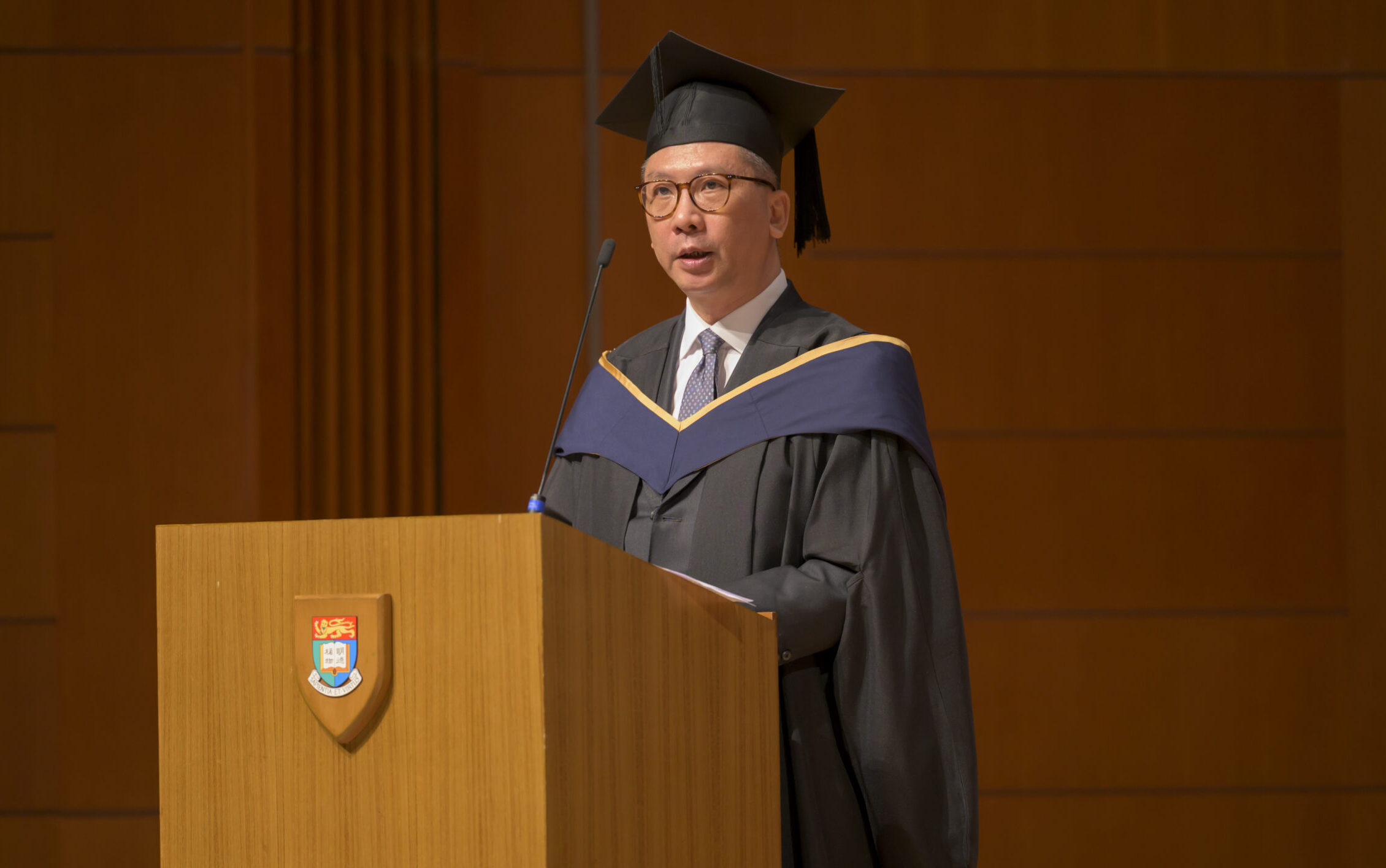
Dean of the Faculty Professor Fu, Members of the Faculty, Law Graduates, Distinguish Guests, Ladies and Gentlemen:
- It is a great honour and privilege to have this opportunity to address you on this happy and memorable occasion.
- I regard this as a happy and memorable occasion because it is not easy to get into a law school as reputable as the Law Faculty of the University of Hong Kong in the first place, and it is no easier to go through the challenges in the course of study and eventually did well enough to graduate.
- May I, therefore, begin by offering my warmest congratulations to each of you who are to be conferred a law degree today. My congratulations also extend to your family and friends, as I am sure they have provided you with much support and are very proud of your achievement.
- Graduation means the completion of one chapter in one’s legal study, and the beginning of a new chapter (be it continuation of legal study, the commencement of legal practice or the putting into use of one’s legal knowledge in non-legal fields). At the dawn of a new chapter, it is an appropriate time to ask ourselves the question: How are we going to face the ever changing world and the consequential changes to the legal landscape and legal practice?
- To begin with, one should fully appreciate that the world is not just evolving but evolving fast and so are our legal environments. Indeed, changes we experienced in the past decade (if not in the past few years) have been much faster than what we have witnessed before.
- Legal studies and legal practice do not exist in a vacuum; instead, they reflect the state of development of the community involved. A few examples will illustrate this.
- When I first started my practice in the late 1980s, domestic payment system relied heavily on cheque whilst cross-border payments generally relied on letter of credit. In those days, cheque disputes and letter of credit disputes were common at different levels of court. Nowadays, physical cheques are used far less than before so much so that some of the law students I have come across told me that they have never seen a physical cheque.
- Another example of change is how disputes are resolved. In the late 1980s, court litigation was the predominant form of dispute resolution. Modern arbitration was at the time still at its infancy stage, although it started to gather momentum after the setting up of the Hong Kong International Arbitration Centre in 1985 and upon the adoption of the UNCITRAL Model Law on International Commercial Arbitrations as a result of the first report published by the then newly set up Law Reform Commission.
- Nowadays, court litigation remains important but is only one of the various forms of dispute resolution. Arbitration and mediation are no longer described as “alternative dispute resolutions” (ADR), and “litigation departments” in law firms are now more popularly known as “dispute resolution departments”. Indeed, the total number of disputes administered by arbitral institutions in Hong Kong (and the amounts involved) are no less significant than those handled by the Court of First Instance.
- What I have just mentioned are only a few of the examples that illustrate the evolution of our legal landscape. There are of course other changes that we have experienced in the past decade or two. As of now, significant changes are brought about by technological advances and other important issues such as climate change and sustainable development. The popularity of cryptocurrencies, the rise of stable coins, the use of smart contracts and Artificial Intelligence (AI) are but some of the driving forces that are generating impacts at both domestic and global levels.
- With these developments and changes, legal practice and legal studies will and should no longer be the same.
- First, the use of AI is the elephant in the room that no one can ignore. Indeed, there has been suggestion that the legal profession is one of the sectors that will be most affected by the use of AI.
- I do not object to legal practitioners using AI to assist their practice. No one can deny that in certain areas, the use of AI can provide real assistance and thereby save time and resources. Indeed, future generations of legal practitioners probably cannot survive without a good working knowledge of AI.
- However, putting aside problematic issues such as AI hallucination and at the risk of being described as old-school (of which I am), I would caution against excessive reliance on AI or the overplay of what AI can do in the legal context. The practice of law is not and should not be a mechanical process. Resolution of disputes, whether through court litigation or arbitration, is not and should not be a factory production line. The ultimate objective is not resolution of disputes per se, but resolution of disputes in a fair and just manner that commands confidence and trust in the system.
- Unlike mathematical calculation, the appropriate resolution of any legal issues is not just the feeding of data into a computer installed with the relevant formula. The practice of law involves a strong sense of humanity. It requires the weighing and balancing of opposing considerations; it requires empathy as well as a good sense of proper judgment as to what is fair and right in the circumstances.
- Two examples will illustrate this. First, matrimonial disputes involving the custody of children. As the law now stands, the welfare and interest of the child involved is paramount. Question: are we going to leave such delicate questions to AI? Second, criminal trials before the Court of First Instance involve the use of jury. Jury trial is a form of safeguard so that ordinary people from different backgrounds can deliberate and decide on the guilt or innocence of the accused. Question: are we confident (at least at this stage) that AI can replace the role of juries? These are not rhetorical questions; these are questions that deserve serious consideration as time goes by and as technology advances further.
- In short, I have no doubt that AI will be a significant force in shaping the legal landscape. However, legal studies, legal research, legal practice and dispute resolution should retain their fundamental nature of humanity. A good lawyer requires not only good legal knowledge, what matters most is his/her sound judgment and sense of justice.
- Second, the practice of law in the past was generally domestic in nature, with different jurisdictions’ lawyers comfortably focusing on the law of their own jurisdictions. However, as a result of the global development we have seen and irrespective of whether one still advocates globalization, legal practice is getting more and more international in nature. This point is of particular relevance to Hong Kong. Hong Kong has been and remains an international city. The continuous success of Hong Kong will depend on whether it can remain an international city and distinguish herself from other cities in the Chinese Mainland.
- As I noted earlier, legal studies and legal practice do not exist in a vacuum. Applying this concept in the context of Hong Kong, our future generations of lawyers require a solid international perspective who can help to shape and consolidate Hong Kong as an international city. Such an international perspective cannot be derived solely from textbooks, it requires you to be alert to current events happening at the international level (including, in particular, to development of the international legal landscape).
- Before I conclude, may I stress one point. I have said a lot about changes and developments. One aspect is perhaps an exception, and that is the importance of maintaining and fortifying the concept of the rule of law. The legal environment changes, the law changes and the legal practice changes. However, the one and most important notion that we should steadfastly safeguard is our rule of law. That’s the fundamental mission of every law student, law scholar, legal practitioner and judicial officer, and a mission that the Hong Kong society can legitimately expect every member of our legal community (including our law graduates) to hold dear to our heart.
- On this note, may I again congratulate the graduates and may I wish all of you every success in whatever ventures you choose for yourselves.
Thank you.